


Offset printing meets the ESG world
ZERO WASTE INKS
European demand for printing inks is around 1 million tonnes per year, most of which concern inks formulated with vegetable solvents based on palm oil, soya, coconut, etc. These inks today are mainly used for printing food packaging and are based on vegetable oil esters. These are therefore solvents that use oils deriving from crops that subtract soil for the cultivation of oils for the food industry, thus impacting the food chain and food sustainability. Ultimately, oils from the food industry are used for non-food purposes.
“Zero waste INKS”, born from the synergy between IPINKS and the Department of Chemical Sciences of Naples with the group of “Chimica Metallorganica”, which has been dealing with the conversion of waste oils for years, has set itself the objective of reducing the impact of these inks on the environment.
After a series of successful tests and publications, a family of “green” solvents derived from third generation residual biomass (food waste or marginal crops) have been patented for the formulation of eco-friendly inks with a view to the circular economy”.
RESEARCH
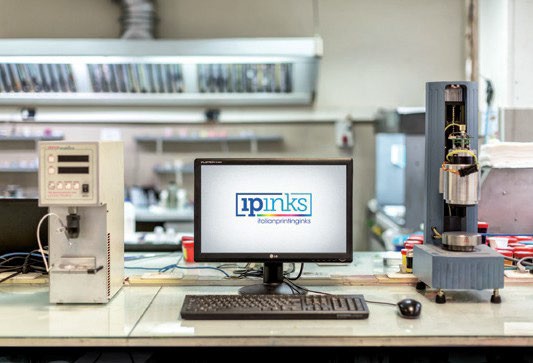
Observing the similarity between the molecules used within the printing inks that IPINKS produced and the derivatives of waste oils created in the laboratory by the University, the company has supported tests and studies since 2017 to understand if these new products could be inserted into the system instead of those in use, which are decidedly less environmentally friendly. The results were surprising, the solvent power was far superior and in 2019 the first important production was started with positive effects both in printing on food packaging and for commercial and editorial products.
From here the startup IsusChem was born which, thanks also to important funding from the European Community, built a plant to produce (European Patent EP7049428) on a semi-industrial scale this family of solvents deriving from waste oils and marginal crops (European Patent EP3577173) such as thistle and safflower with no impact on the food chain.
INNOVATIVE APPLICATION
Once the potential of this new family of solvents was learned, IPINKS invested and supported further studies by the University in various application areas from a technological point of view.
Other patents have been created in the graphics sector and beyond, with product but also process innovation: cleaning solvents for printing machines/surfaces have been created and, in the last year, a very low-cost recyclable catalyst has also been developed which supplies esters to make UV inks. The sectors in which studies are underway range from cosmetics, for example in formulations for sun creams or hair treatment products, to the production of ceramic coatings.
ADVANTAGES
The innovation makes printing products 35-40% more sustainable from the point of view of the use of solvents and reduces CO2 emissions by over 50% for the printing ink production process, already reaching the objectives of the 2030 agenda. 35-40% of the formulation of a printing ink, as already mentioned, although coming from a plant-based raw material, consumes soil and competes with the cultivation of food products. Therefore, despite being a vegetable raw material, it is not ethically and environmentally sustainable. Using esters that derive from waste oils or marginal crops reduces the environmental impact, increases the sustainability of the inks, of the final packaging, gives added value to the used frying oil which would otherwise be thermally destroyed (therefore producing CO2) and in case of marginal crops, gives new life and new value to land now unsuitable for food cultivation. Furthermore, in this way, the packaging on which the ink is used is also more sustainable, up to 25% in terms of overall CO2 emissions. Important studies are at an advanced stage, the aim of which is to obtain greater recyclability of printed packaging, thanks to better removal of our ReNewInk inks.
A further advantage of using these esters is that they make the production of printing inks faster and less energy-intensive. Suffice it to say that the dissolution process of the various components would take 4 hours at a temperature of 120°, whereas with the new solvents it is achieved in 30 minutes and at a temperature of 80°.
Thanks to their extraordinary characteristics, these products do not just replace something already existing but open up new markets both in the printing sector and in other industrial sectors.
Finally, the new “green” inks do not migrate into foods and have an eco-toxicological profile that makes them suitable for use in food packaging. They are not flammable nor do they cause irritation. They do not require particular precautions to be handled, a further advantage for the safety of the operators who use them.
APPLICATIONS
The inks that we produce with solvents from waste oils can be used on coated paper and cardboard and
uncoated, but also on label paper and non-absorbent substrates such as bipolythene-coated cardboard used in the paper cups sector. This latest application is where the greatest added value for our people is highlighted
inks as current inks are very high in viscosity and difficult to process. Our inks, on the other hand, are equipped with a rheological profile very similar to conventional offset inks, simplifying the printing phases. The improvement is due to the exceptional solvent power of the products we use with the further advantage for users of being able to operate effectively with less impact on the environment
Our products are already available and we expect significant growth in 2024 as the production of these solvents from waste oils will grow greatly thanks to our key partner Isuschem who together with us holds the intellectual property on the product and process and we both strongly believe in one industrial development that is sustainable for the environment and for future generations.
PRINTING FEATURES
The printing characteristics of these inks come from the exceptional solvent power of the substances we use. This greater solvent power allows us to use very flexible and high-performance formulations at high printing speeds with very rapid drying characteristics even on non-absorbent substrates.
These performances allow the final print to achieve a notable increase in brilliance and surprising print quality. Industrial tests have shown a very low dot gain thanks to an excellent ink-water balance even at very high printing speeds. A further benefit is rub resistance that is much higher than current market standards.
INNOVATION AWARD
Italian printing inks, better known as ipinks, won the 2022 innovation award at the latest smau naples for having presented the renewinks series, the series of printing ink that uses solvents coming from waste of edible oils. a virtuous process carried out by the caserta-based company, extremely vivid in the search for new solutions to offer to the packaging printing market.
The Smau Innovation Award is a recognition that rewards the great propensity for innovation of Italian companies, regardless of the sector in which they operate, in particular projects relating to Sustainability and Open Innovation, capable of bringing benefits to their business through collaboration with startups and businesses innovative in a partnership logic.